Only Red Algae Can Grow in Relatively Deep Regions of the Ocean Because Red Algae Are:
| Red algae Temporal range: | |
|---|---|
 | |
| A-D : Chondrus crispus Stackhouse, Eastward-F : Mastocarpus stellatus J.Ag. | |
Scientific classification  (disputed) | |
| Domain: | Eukaryota |
| (unranked): | Diaphoretickes |
| (unranked): | Archaeplastida |
| Sectionalization: | Rhodophyta Wettstein, 1922 |
Red algae, or Rhodophyta ( roh-DOF-ih-tə, ROH-də-FY-tə; from Aboriginal Greek ῥόδον ( rhódon ) 'rose', and φυτόν ( phutón ) 'establish'), are ane of the oldest groups of eukaryotic algae.[3] The Rhodophyta likewise comprises one of the largest phyla of algae, containing over seven,000 currently recognized species with taxonomic revisions ongoing.[4] The majority of species (6,793) are found in the Florideophyceae (grade), and mostly consist of multicellular, marine algae, including many notable seaweeds.[iv] [five] Ruby algae are abundant in marine habitats but are relatively rare in freshwaters.[half dozen] Approximately 5% of the cerise algae occur in freshwater environments with greater concentrations found in warmer areas.[7] Except for two coastal cave dwelling species in the asexual course Cyanidiophyceae, there are no terrestrial species, which may be due to an evolutionary clogging where the terminal mutual antecedent lost well-nigh 25% of its cadre genes and much of its evolutionary plasticity.[8] [9]
The ruby algae form a distinct grouping characterized by having eukaryotic cells without flagella and centrioles, chloroplasts that lack external endoplasmic reticulum and incorporate unstacked (stroma) thylakoids, and use phycobiliproteins as accessory pigments, which give them their red color.[ten] Red algae store sugars as floridean starch, which is a type of starch that consists of highly branched amylopectin without amylose,[11] as food reserves outside their plastids. Most red algae are too multicellular, macroscopic, marine, and reproduce sexually. The red algal life history is typically an alternation of generations that may have three generations rather than two.[12] The coralline algae, which secrete calcium carbonate and play a major role in building coral reefs, vest here. Red algae such as dulse (Palmaria palmata) and laver (nori/gim) are a traditional part of European and Asian cuisines and are used to make other products such every bit agar, carrageenans and other food additives.[thirteen]
Development [edit]

Botryocladia occidentalis scale bar: two cm
Chloroplasts evolved following an endosymbiotic upshot between an ancestral, photosynthetic cyanobacterium and an early eukaryotic phagotroph.[14] This consequence (termed primary endosymbiosis) resulted in the origin of the red and green algae, and the glaucophytes, which make up the oldest evolutionary lineages of photosynthetic eukaryotes.[15] A secondary endosymbiosis event involving an ancestral cerise alga and a heterotrophic eukaryote resulted in the evolution and diversification of several other photosynthetic lineages such as Cryptophyta, Haptophyta, Stramenopiles (or Heterokontophyta), and Alveolata.[xv] In addition to multicellular brown algae, it is estimated that more than half of all known species of microbial eukaryotes harbor crimson-alga-derived plastids.[16]
Ruby-red algae are divided into the Cyanidiophyceae, a class of unicellular and thermoacidophilic extremophiles institute in sulphuric hot springs and other acidic environments,[17] an adaptation partly made possible by horizontal cistron transfers from prokaryotes,[xviii] with near i% of their genome having this origin,[nineteen] and ii sister clades called SCRP (Stylonematophyceae, Compsopogonophyceae, Rhodellophyceae and Porphyridiophyceae) and BF (Bangiophyceae and Florideophyceae), which are found in both marine and freshwater environments. The SCRP clade are microalgae, consisting of both unicellular forms and multicellular microscopic filaments and blades. The BF are macroalgae, seaweed that usually do not abound to more than about 50 cm in length, but a few species can reach lengths of 2 m.[xx] Most rhodophytes are marine with a worldwide distribution, and are often plant at greater depths compared to other seaweeds. While this was formerly attributed to the presence of pigments (such every bit phycoerythrin) that would allow red algae to inhabit greater depths than other macroalgae by chromatic adaption, recent testify calls this into question (e.yard. the discovery of green algae at great depth in the Bahamas).[21] Some marine species are found on sandy shores, while most others can exist establish fastened to rocky substrata.[22] Freshwater species account for 5% of red algal diversity, but they too accept a worldwide distribution in diverse habitats;[7] they by and large adopt clean, high-catamenia streams with articulate waters and rocky bottoms, but with some exceptions.[23] A few freshwater species are found in black waters with sandy bottoms [24] and even fewer are establish in more lentic waters.[25] Both marine and freshwater taxa are represented past free-living macroalgal forms and smaller endo/epiphytic/zoic forms, significant they live in or on other algae, plants, and animals.[10] In addition, some marine species have adopted a parasitic lifestyle and may be found on closely or more distantly related crimson algal hosts.[26] [27]
Taxonomy [edit]
In the system of Adl et al. 2005, the red algae are classified in the Archaeplastida, forth with the glaucophytes and light-green algae plus land plants (Viridiplantae or Chloroplastida). The authors employ a hierarchical arrangement where the clade names do not signify rank; the class proper noun Rhodophyceae is used for the red algae. No subdivisions are given; the authors say, "Traditional subgroups are artificial constructs, and no longer valid."[28]
Many studies published since Adl et al. 2005 have provided testify that is in agreement for monophyly in the Archaeplastida (including red algae).[29] [30] [31] [32] Nonetheless, other studies take suggested Archaeplastida is paraphyletic.[33] [34] As of Jan 2011[update], the state of affairs appears unresolved.
Beneath are other published taxonomies of the cerise algae using molecular and traditional blastoff taxonomic data; however, the taxonomy of the red algae is still in a state of flux (with classification above the level of order having received little scientific attention for most of the 20th century).[35]
- If one defines the kingdom Plantae to mean the Archaeplastida, the ruby-red algae will exist function of that kingdom.
- If Plantae are defined more narrowly, to exist the Viridiplantae, and then the cherry-red algae might be considered their ain kingdom, or part of the kingdom Protista.
A major enquiry initiative to reconstruct the Ruby-red Algal Tree of Life (RedToL) using phylogenetic and genomic approach is funded by the National Science Foundation every bit role of the Assembling the Tree of Life Plan.
Nomenclature comparison [edit]
| Classification system according to Saunders and Hommersand 2004 [35] | Nomenclature organization co-ordinate to Hwan Su Yoon et al. 2006 [36] | Orders | Multicelluar? | Pit plugs? | Example |
|---|---|---|---|---|---|
|
| Cyanidiales | No | No | Cyanidioschyzon merolae |
|
| Rhodellales | No | No | Rhodella |
|
| Compsopogonales, Rhodochaetales, Erythropeltidales | Yes | No | Compsopogon |
| Rufusiales, Stylonematales | Yes | No | Stylonema | |
|
| Bangiales | Aye | Yep | Bangia, "Porphyra" |
| Porphyridiales | No | No | Porphyridium cruentum | |
|
| Hildenbrandiales | Yes | Yes | Hildenbrandia |
| Batrachospermales, Balliales, Balbianiales, Nemaliales, Colaconematales, Acrochaetiales, Palmariales, Thoreales | Yes | Yes | Nemalion | |
| Rhodogorgonales, Corallinales | Yeah | Aye | Corallina officinalis | ||
| Ahnfeltiales, Pihiellales | Yes | Yes | Ahnfeltia | |
| Bonnemaisoniales, Gigartinales, Gelidiales, Gracilariales, Halymeniales, Rhodymeniales, Nemastomatales, Plocamiales, Ceramiales | Yes | Yeah | Gelidium |
Some sources (such every bit Lee) place all ruby algae into the class "Rhodophyceae". (Lee's organization is not a comprehensive classification, but a choice of orders considered mutual or important.[37])
A subphylum - Proteorhodophytina - has been proposed to encompass the existing classes Compsopogonophyceae, Porphyridiophyceae, Rhodellophyceae and Stylonematophyceae.[38] This proposal was made on the basis of the analysis of the plastid genomes.
Species of ruby-red algae [edit]
Over seven,000 species are currently described for the scarlet algae,[4] but the taxonomy is in constant flux with new species described each year.[35] [36] The vast majority of these are marine with well-nigh 200 that live only in fresh water.
Some examples of species and genera of reddish algae are:
- Cyanidioschyzon merolae, a primitive red alga
- Atractophora hypnoides
- Gelidiella calcicola
- Lemanea, a freshwater genus
- Palmaria palmata, dulse
- Schmitzia hiscockiana
- Chondrus crispus, Irish moss
- Mastocarpus stellatus
- Vanvoorstia bennettiana, became extinct in the early 20th century
- Acrochaetium efflorescens
- Audouinella, with freshwater as well as marine species
- Polysiphonia ceramiaeformis, banded siphon weed
- Vertebrata simulans
Morphology [edit]
Cerise algal morphology is diverse ranging from unicellular forms to complex parenchymatous and non- parenchymatous thallus.[39] Red algae have double cell walls.[40] The outer layers contain the polysaccharides agarose and agaropectin that tin be extracted from the cell walls by boiling as agar.[40] The internal walls are generally cellulose.[forty] They as well take the almost gene-rich plastid genomes known.[41]
Jail cell structure [edit]
Red algae exercise not accept flagella and centrioles during their entire life cycle. Presence of normal spindle fibres, microtubules, un-stacked photosynthetic membranes, presence of phycobilin paint granules,[42] presence of pit connexion betwixt cells filamentous genera, absence of chloroplast endoplasmic reticulum are the distinguishing characters of blood-red algal jail cell structure.[43]
Chloroplasts [edit]
Presence of the water-soluble pigments chosen phycobilins (phycocyanobilin, phycoerythrobilin, phycourobilin and phycobiliviolin), which are localized into phycobilisomes, gives red algae their distinctive color.[44] Chloroplast contains evenly spaced and ungrouped thylakoids.[45] Other pigments include chlorophyll a, α- and β-carotene, lutein and zeaxanthin. Double membrane of chloroplast envelope surrounds the chloroplast. Absence of grana and attachment of phycobilisomes on the stromal surface of the thylakoid membrane are other distinguishing characters of red algal chloroplast.[46]
Storage products [edit]
The major photosynthetic products include floridoside (major production), D‐isofloridoside, digeneaside, mannitol, sorbitol, dulcitol etc.[47] Floridean starch (similar to amylopectin in country plants), a long term storage product, is deposited freely (scattered) in the cytoplasm.[48] The concentration of photosynthetic products are altered by the environmental conditions like change in pH, the salinity of medium, change in low-cal intensity, nutrient limitation etc.[49] When the salinity of the medium increases the production of floridoside is increased in gild to prevent water from leaving the algal cells.
Pit connections and pit plugs [edit]
Pit connections [edit]
Pit connections and pit plugs are unique and distinctive features of scarlet algae that class during the process of cytokinesis following mitosis.[50] [51] In red algae, cytokinesis is incomplete. Typically, a small pore is left in the center of the newly formed partition. The pit connexion is formed where the daughter cells remain in contact.
Shortly after the pit connection is formed, cytoplasmic continuity is blocked by the generation of a pit plug, which is deposited in the wall gap that connects the cells.
Connections betwixt cells having a common parent cell are called master pit connections. Because apical growth is the norm in blood-red algae, most cells have ii main pit connections, one to each side by side cell.
Connections that be betwixt cells not sharing a common parent prison cell are labelled secondary pit connections. These connections are formed when an unequal prison cell division produced a nucleated girl cell that so fuses to an adjacent cell. Patterns of secondary pit connections can be seen in the order Ceramiales.[51]
Pit plugs [edit]
After a pit connectedness is formed, tubular membranes appear. A granular protein called the plug cadre and then forms around the membranes. The tubular membranes eventually disappear. While some orders of red algae merely take a plug core, others accept an associated membrane at each side of the poly peptide mass, chosen cap membranes. The pit plug continues to exist between the cells until i of the cells dies. When this happens, the living cell produces a layer of wall material that seals off the plug.
Role [edit]
The pit connections have been suggested to function every bit structural reinforcement, or as avenues for cell-to-jail cell communication and transport in red algae, notwithstanding piddling information supports this hypothesis.[52]
Reproduction [edit]
The reproductive wheel of carmine algae may be triggered by factors such as twenty-four hour period length.[3] Red algae reproduce sexually as well as asexually. Asexual reproduction can occur through the production of spores and by vegetative means (fragmentation, cell division or propagules product).[53]
Fertilization [edit]
Red algae lack motile sperm. Hence, they rely on water currents to transport their gametes to the female organs – although their sperm are capable of "gliding" to a carpogonium'south trichogyne.[3]
The trichogyne will continue to abound until it encounters a spermatium; once it has been fertilized, the prison cell wall at its base of operations progressively thickens, separating it from the residual of the carpogonium at its base.[3]
Upon their collision, the walls of the spermatium and carpogonium dissolve. The male nucleus divides and moves into the carpogonium; ane half of the nucleus merges with the carpogonium'due south nucleus.[iii]
The polyamine spermine is produced, which triggers carpospore production.[3]
Spermatangia may take long, delicate appendages, which increase their chances of "hooking up".[3]
Life cycle [edit]
They display alternation of generations. In addition to a gametophyte generation, many have ii sporophyte generations, the carposporophyte-producing carpospores, which germinate into a tetrasporophyte – this produces spore tetrads, which dissociate and germinate into gametophytes.[3] The gametophyte is typically (but not always) identical to the tetrasporophyte.[54]
Carpospores may too germinate directly into thalloid gametophytes, or the carposporophytes may produce a tetraspore without going through a (free-living) tetrasporophyte stage.[54] Tetrasporangia may be bundled in a row (zonate), in a cross (cruciate), or in a tetrad.[3]
The carposporophyte may be enclosed within the gametophyte, which may comprehend information technology with branches to form a cystocarp.[54]
The two following instance studies may be helpful to empathize some of the life histories algae may display:
In a uncomplicated case, such as Rhodochorton investiens:
- In the carposporophyte: a spermatium merges with a trichogyne (a long pilus on the female sexual organ), which then divides to form carposporangia – which produce carpospores.
- Carpospores germinate into gametophytes, which produce sporophytes. Both of these are very similar; they produce monospores from monosporangia "just below a cross-wall in a filament"[3] and their spores are "liberated through the apex of sporangial cell."[3]
- The spores of a sporophyte produce either tetrasporophytes. Monospores produced by this phase germinates immediately, with no resting stage, to form an identical copy of the parent. Tetrasporophytes may also produce a carpospore, which germinates to form another tetrasporophyte.[ verification needed ] [3]
- The gametophyte may replicate using monospores, but produces sperm in spermatangia, and "eggs"(?) in carpogonium.[3]
A rather dissimilar instance is Porphyra gardneri:
- In its diploid phase, a carpospore can germinate to course a filamentous "conchocelis phase", which tin can also self-replicate using monospores. The conchocelis stage eventually produces conchosporangia. The resulting conchospore germinates to form a tiny prothallus with rhizoids, which develops to a cm-scale leafy thallus. This too can reproduce via monospores, which are produced inside the thallus itself.[3] They tin as well reproduce via spermatia, produced internally, which are released to encounter a prospective carpogonium in its conceptacle.[three]
Chemical science [edit]
| Algal group | δthirteenC range[55] |
|---|---|
| HCO3-using red algae | −22.5‰ to −9.6‰ |
| COii-using red algae | −34.5‰ to −29.9‰ |
| Brownish algae | −xx.8‰ to −10.5‰ |
| Greenish algae | −20.3‰ to −8.viii‰ |
The δ 13C values of red algae reflect their lifestyles. The largest deviation results from their photosynthetic metabolic pathway: algae that utilise HCO3 as a carbon source have less negative δ 13C values than those that only use COii.[55] An additional difference of about one.71‰ separates groups intertidal from those beneath the lowest tide line, which are never exposed to atmospheric carbon. The latter group uses the more thirteenC-negative CO2 dissolved in body of water water, whereas those with admission to atmospheric carbon reflect the more than positive signature of this reserve.
Photosynthetic pigments of Rhodophyta are chlorophylls a and d. Ruby algae are red due to phycoerythrin. They comprise the sulfated polysaccharide carrageenan in the amorphous sections of their cell walls, although red algae from the genus Porphyra contain porphyran. They also produce a specific type of tannin called phlorotannins, only in a lower amount than dark-brown algae do.
Genomes and transcriptomes of ruby algae [edit]
Equally enlisted in realDB,[56] 27 complete transcriptomes and 10 complete genomes sequences of cerise algae are bachelor. Listed below are the x consummate genomes of ruby algae.
- Cyanidioschyzon merolae, Cyanidiophyceae[57] [58]
- Galdieria sulphuraria, Cyanidiophyceae[59]
- Pyropia yezoensis, Bangiophyceae[sixty]
- Chondrus crispus, Florideophyceae[61]
- Porphyridium purpureum, Porphyridiophyceae[62]
- Porphyra umbilicalis, Bangiophyceae[63]
- Gracilaria changii, Gracilariales[64]
- Galdieria phlegrea, Cyanidiophytina[65]
- Gracilariopsis lemaneiformis, Gracilariales[66]
- Gracilariopsis chorda, Gracilariales[67]
Fossil record [edit]
One of the oldest fossils identified as a scarlet alga is too the oldest fossil eukaryote that belongs to a specific modern taxon. Bangiomorpha pubescens, a multicellular fossil from chill Canada, strongly resembles the modern ruby-red alga Bangia and occurs in rocks dating to ane.05 billion years ago.[2]
2 kinds of fossils resembling red algae were found sometime between 2006 and 2011 in well-preserved sedimentary rocks in Chitrakoot, central India. The presumed ruby algae lie embedded in fossil mats of cyanobacteria, called stromatolites, in one.half-dozen billion-yr-old Indian phosphorite – making them the oldest plant-like fossils ever found by about 400 million years.[68]
Carmine algae are important builders of limestone reefs. The primeval such coralline algae, the solenopores, are known from the Cambrian menstruum. Other algae of different origins filled a similar office in the late Paleozoic, and in more recent reefs.
Calcite crusts that have been interpreted as the remains of coralline reddish algae, date to the Ediacaran Period.[69] Thallophytes resembling coralline red algae are known from the late Proterozoic Doushantuo formation.[lxx]
Human relationship to other algae [edit]
Chromista and Alveolata algae (e.g., chrysophytes, diatoms, phaeophytes, dinophytes) seem to have evolved from bikonts that have acquired red algae equally endosymbionts. According to this theory, over time these endosymbiont red algae have evolved to get chloroplasts. This part of endosymbiotic theory is supported by various structural and genetic similarities.[71]
Human consumption [edit]
Crimson algae have a long history of employ as a source of nutritional, functional food ingredients and pharmaceutical substances.[72] They are a source of antioxidants including polyphenols, and phycobiliproteins[73] and contain proteins, minerals, trace elements, vitamins and essential fat acids.[74] [75] Traditionally red algae are eaten raw, in salads, soups, meal and condiments. Several species are food crops, in particular members of the genus Porphyra, variously known as nori (Japan), gim (Korea), 紫菜 (China). Laver and Dulse (Palmaria palmata)[76] are consumed in Britain.[77] Some of the carmine algal species similar Gracilaria and Laurencia are rich in polyunsaturated fat acids (eicopentaenoic acid, docohexaenoic acid, arachidonic acid)[78] and have protein content up to 47% of total biomass.[72] Where a big portion of world population is getting insufficient daily iodine intake, a 150 ug/day requirement of iodine is obtained from a unmarried gram of red algae.[79] Red algae, like Gracilaria, Gelidium, Euchema, Porphyra, Acanthophora, and Palmaria are primarily known for their industrial utilise for phycocolloids (agar, algin, furcellaran and carrageenan) as thickening agent, textiles, food, anticoagulants, water-binding agents etc.[eighty] Dulse (Palmaria palmata) is i of the most consumed red algae and is a source of iodine, protein, magnesium and calcium.[ citation needed ] China, Japan, Republic of Korea are the top producers of seaweeds.[81] In East and Southeast Asia, agar is almost commonly produced from Gelidium amansii. These rhodophytes are easily grown and, for case, nori tillage in Nihon goes dorsum more than three centuries.[ citation needed ]
Gallery [edit]
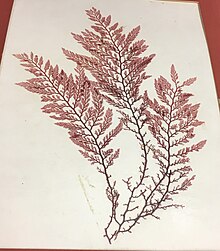
-

-

-
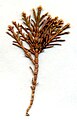
-
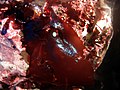
Some carmine algae are irised when not covered with water
Encounter also [edit]
- Brown algae
- Green algae
- History of phycology
References [edit]
- ^ N. J. Butterfield (2000). "Bangiomorpha pubescens n. gen., northward. sp.: implications for the evolution of sex, multicellularity, and the Mesoproterozoic/Neoproterozoic radiation of eukaryotes". Paleobiology. 26 (3): 386–404. doi:x.1666/0094-8373(2000)026<0386:BPNGNS>2.0.CO;2. ISSN 0094-8373.
- ^ a b T.K. Gibson (2018). "Precise historic period of Bangiomorpha pubescens dates the origin of eukaryotic photosynthesis". Geology. 46 (2): 135–138. doi:ten.1130/G39829.1.
- ^ a b c d e f g h i j m l 1000 n o Lee, R.East. (2008). Phycology (fourth ed.). Cambridge University Press. ISBN978-0-521-63883-8.
- ^ a b c Guiry, M.D.; Guiry, Chiliad.Chiliad. (2016). "Algaebase". www.algaebase.org . Retrieved November twenty, 2016.
- ^ D. Thomas (2002). Seaweeds. Life Series. Natural History Museum, London. ISBN978-0-565-09175-0.
- ^ Dodds, Walter One thousand. (Walter Kennedy), 1958- (seven May 2019). Freshwater environmental : concepts and environmental applications of limnology. Whiles, Matt R. (Third ed.). London, United Kingdom. ISBN9780128132555. OCLC 1096190142.
{{cite book}}: CS1 maint: multiple names: authors listing (link) - ^ a b Sheath, Robert G. (1984). "The biology of freshwater scarlet algae". Progress Phycological Research. iii: 89–157.
- ^ Why don't nosotros live on a cerise planet?
- ^ Azua-Bustos, A; González-Silva, C; Arenas-Fajardo, C; Vicuña, R (2012). "Extreme environments as potential drivers of convergent evolution by exaptation: the Atacama Desert Littoral Range instance". Forepart Microbiol. iii: 426. doi:ten.3389/fmicb.2012.00426. PMC3526103. PMID 23267354.
- ^ a b W. J. Woelkerling (1990). "An introduction". In 1000. Thou. Cole; R. K. Sheath (eds.). Biological science of the Cherry Algae. Cambridge University Printing, Cambridge. pp. i–6. ISBN978-0-521-34301-5.
- ^ Viola, R.; Nyvall, P.; Pedersén, G. (2001). "The unique features of starch metabolism in cherry algae". Proceedings of the Imperial Society of London B. 268 (1474): 1417–1422. doi:ten.1098/rspb.2001.1644. PMC1088757. PMID 11429143.
- ^ "Algae". autocww.colorado.edu.
- ^ Grand. D. Guiry. "Rhodophyta: ruby algae". National University of Republic of ireland, Galway. Archived from the original on 2007-05-04. Retrieved 2007-06-28 .
- ^ Gould, Southward.B.; Waller, R.F.; McFadden, G.I. (2008). "Plastid Evolution". Annual Review of Constitute Biology. 59: 491–517. doi:10.1146/annurev.arplant.59.032607.092915. PMID 18315522. S2CID 30458113.
- ^ a b McFadden, K.I. (2001). "Primary and Secondary Endosymbiosis and the Evolution of Plastids". Periodical of Phycology. 37 (six): 951–959. doi:10.1046/j.1529-8817.2001.01126.x. S2CID 51945442.
- ^ Steal My Sunshine | The Scientist Magazine
- ^ Ciniglia, C.; Yoon, H.; Pollio, A.; Bhattacharya, D. (2004). "Hidden biodiversity of the extremophilic Cyanidiales ruby-red algae". Molecular Ecology. 13 (7): 1827–1838. doi:x.1111/j.1365-294X.2004.02180.x. PMID 15189206. S2CID 21858509.
- ^ Plants and animals sometimes have genes from bacteria, report of algae suggests - Sciencemag.org
- ^ The genomes of polyextremophilic cyanidiales contain i% horizontally transferred genes with various adaptive functions
- ^ Brawley, SH (2017). "Insights into the red algae and eukaryotic evolution from the genome of Porphyra umbilicalis (Bangiophyceae, Rhodophyta)". Proceedings of the National Academy of Sciences of the United States of America. 114 (31): E6361–E6370. doi:10.1073/pnas.1703088114. PMC5547612. PMID 28716924.
- ^ Norris, J. N.; Olsen, J. L. (1991). "Deep-water greenish algae from the Bahama islands, including Cladophora vandenhoekii sp. november. (Cladophorales)". Phycologia. 30 (four): 315–328. doi:10.2216/i0031-8884-xxx-4-315.i. ISSN 0031-8884.
- ^ Kain, J.M.; Norton, T.A. (1990). "Marine Ecology". In Cole, J.1000.; Sheath, R.M. (eds.). Biology of the Carmine Algae. Cambridge, U.Yard.: Cambridge University Press. pp. 377–423. ISBN978-0521343015.
- ^ Eloranta, P.; Kwandrans, J. (2004). "Indicator value of freshwater red algae in running waters for water quality cess" (PDF). International Journal of Oceanography and Hydrobiology. XXXIII (1): 47–54. ISSN 1730-413X. Archived from the original (PDF) on 2011-07-27.
- ^ Vis, M.L.; Sheath, R.G.; Chiasson, W.B. (2008). "A survey of Rhodophyta and associated macroalgae from coastal streams in French Guiana". Cryptogamie Algologie. 25: 161–174.
- ^ Sheath, R.M.; Hambrook, J.A. (1990). "Freshwater Ecology". In Cole, K.M.; Sheath, R.G. (eds.). Biological science of the Blood-red Algae. Cambridge, U.K.: Cambridge University Printing. pp. 423–453. ISBN978-0521343015.
- ^ Goff, 50.J. (1982). "The biology of parasitic red algae". Progress Phycological Research. one: 289–369.
- ^ Salomaki, Eastward.D.; Lane, C.E. (2014). "Are all red algal parasites cut from the same cloth?". Acta Societatis Botanicorum Poloniae. 83 (4): 369–375. doi:10.5586/asbp.2014.047.
- ^ Adl, Sina G.; et al. (2005). "The New Higher Level Classification of Eukaryotes with Emphasis on the Taxonomy of Protists". Periodical of Eukaryotic Microbiology. 52 (5): 399–451. doi:10.1111/j.1550-7408.2005.00053.ten. PMID 16248873. S2CID 8060916.
- ^ Fabien Burki; Kamran Shalchian-Tabrizi; Marianne Minge; Åsmund Skjæveland; Sergey I. Nikolaev; Kjetill S. Jakobsen; Jan Pawlowski (2007). Butler, Geraldine (ed.). "Phylogenomics Reshuffles the Eukaryotic Supergroups". PLOS ONE. two (eight): e790. Bibcode:2007PLoSO...2..790B. doi:10.1371/journal.pone.0000790. PMC1949142. PMID 17726520.
- ^ Burki, Fabien; Inagaki, Yuji; Bråte, Jon; Archibald, John One thousand.; Keeling, Patrick J.; Cavalier-Smith, Thomas; Sakaguchi, Miako; Hashimoto, Tetsuo; Horak, Ales; Kumar, Surendra; Klaveness, Dag; Jakobsen, Kjetill S.; Pawlowski, Jan; Shalchian-Tabrizi, Kamran (2009). "Big-Scale Phylogenomic Analyses Reveal That 2 Enigmatic Protist Lineages, Telonemia and Centroheliozoa, Are Related to Photosynthetic Chromalveolates". Genome Biology and Evolution. 1: 231–8. doi:10.1093/gbe/evp022. PMC2817417. PMID 20333193.
- ^ Cavalier-Smith, Thomas (2009). "Kingdoms Protozoa and Chromista and the eozoan root of the eukaryotic tree". Biological science Letters. 6 (3): 342–5. doi:10.1098/rsbl.2009.0948. PMC2880060. PMID 20031978.
- ^ Rogozin, I.B.; Basu, M.G.; Csürös, 1000. & Koonin, Eastward.V. (2009). "Analysis of Rare Genomic Changes Does Not Support the Unikont–Bikont Phylogeny and Suggests Cyanobacterial Symbiosis equally the Point of Primary Radiation of Eukaryotes". Genome Biology and Evolution. 1: 99–113. doi:ten.1093/gbe/evp011. PMC2817406. PMID 20333181.
- ^ Kim, East.; Graham, Fifty.E. & Graham, Linda E. (2008). Redfield, Rosemary Jeanne (ed.). "EEF2 assay challenges the monophyly of Archaeplastida and Chromalveolata". PLOS ONE. iii (seven): e2621. Bibcode:2008PLoSO...iii.2621K. doi:10.1371/journal.pone.0002621. PMC2440802. PMID 18612431.
- ^ Nozaki, H.; Maruyama, S.; Matsuzaki, M.; Nakada, T.; Kato, S.; Misawa, K. (2009). "Phylogenetic positions of Glaucophyta, green plants (Archaeplastida) and Haptophyta (Chromalveolata) as deduced from slowly evolving nuclear genes". Molecular Phylogenetics and Evolution. 53 (3): 872–880. doi:10.1016/j.ympev.2009.08.015. PMID 19698794.
- ^ a b c G. Westward. Saunders & One thousand. H. Hommersand (2004). "Assessing red algal supraordinal diversity and taxonomy in the context of contemporary systematic data". American Periodical of Botany. 91 (10): 1494–1507. doi:10.3732/ajb.91.10.1494. PMID 21652305. S2CID 9925890.
- ^ a b Hwan Su Yoon; G. M. Müller; R. G. Sheath; F. D. Ott & D. Bhattacharya (2006). "Defining the major lineages of ruby algae (Rhodophyta)" (PDF). Journal of Phycology. 42 (ii): 482–492. doi:ten.1111/j.1529-8817.2006.00210.10. S2CID 27377549.
- ^ Robert Edward Lee (2008). Phycology . Cambridge University Press. pp. 107. ISBN978-0-521-68277-0 . Retrieved 31 January 2011.
- ^ Muñoz-Gómez, SA; Mejía-Franco, FG; Durnin, K; Colp, Yard; Grisdale, CJ; Archibald, JM; Ch, Slamovits (2017). "The new red algal subphylum Proteorhodophytina comprises the largest and near divergent plastid genomes known". Curr Biol. 27 (11): 1677–1684. doi:10.1016/j.cub.2017.04.054. PMID 28528908.
- ^ Goff, 50. J.; Coleman, A. W. (1986). "A Novel Blueprint of Apical Jail cell Polyploidy, Sequential Polyploidy Reduction and Intercellular Nuclear Transfer in the Blood-red Alga Polysiphonia". American Journal of Botany. 73 (8): 1109–1130. doi:ten.1002/j.1537-2197.1986.tb08558.10.
- ^ a b c Fritsch, F. E. (1945), The structure and reproduction of the algae, Cambridge: Cambridge Univ. Press, ISBN0521050421, OCLC 223742770
- ^ Janouškovec, January; Liu, Shao-Lun; Martone, Patrick T.; Carré, Wilfrid; Leblanc, Catherine; Collén, Jonas; Keeling, Patrick J. (2013). "Evolution of Red Algal Plastid Genomes: Ancient Architectures, Introns, Horizontal Cistron Transfer, and Taxonomic Utility of Plastid Markers". PLOS One. 8 (iii): e59001. Bibcode:2013PLoSO...859001J. doi:10.1371/journal.pone.0059001. PMC3607583. PMID 23536846.
- ^ W. J. Woelkerling (1990). "An introduction". In K. K. Cole; R. M. Sheath (eds.). Biological science of the Ruby Algae. Cambridge University Press, Cambridge. pp. i–vi. ISBN 978-0-521-34301-5.
- ^ Scott, J.; Cynthia, B.; Schornstein, K.; Thomas, J. (1980). "Ultrastructure of Cell Division and Reproductive Differentiation of Male Plants in the Florideophyceae (Rhodophyta): Cell Division in Polysiphonia1". Journal of Phycology. 16 (iv): 507–524. doi:10.1111/j.1529-8817.1980.tb03068.10. S2CID 83062611.
- ^ Gantt, Eastward (1969). "Backdrop and Ultrastructure of Phycoerythrin From Porphyridium cruentum12". Constitute Physiology. 44 (eleven): 1629–1638. doi:10.1104/pp.44.11.1629. PMC396315. PMID 16657250.
- ^ The Fine Structure of Algal Cells, 1st Edition. (n.d.). Retrieved October 16, 2019, from https://www.elsevier.com/books/the-fine-construction-of-algal-cells/dodge/978-0-12-219150-3
- ^ Tsekos, I.; Reiss, H.-D.; Orfanidis, Due south.; Orologas, Northward. (1996). "Ultrastructure and supramolecular organization of photosynthetic membranes of some marine red algae". New Phytologist. 133 (4): 543–551. doi:ten.1111/j.1469-8137.1996.tb01923.x.
- ^ Karsten, U.; West, J. A.; Zuccarello, Yard. C.; Engbrodt, R.; Yokoyama, A.; Hara, Y.; Brodie, J. (2003). "Depression Molecular Weight Carbohydrates of the Bangiophycidae (Rhodophyta)1". Journal of Phycology. 39 (3): 584–589. doi:10.1046/j.1529-8817.2003.02192.x. S2CID 84561417.
- ^ Lee, R. E. (1974). Chloroplast structure and starch grain product as phylogenetic indicators in the lower Rhodophyceae. British Phycological Journal, 9(iii), 291–295. doi:x.1080/00071617400650351
- ^ "Low Molecular Weight Carbohydrates in Red Algae – an Ecophysiological and Biochemical Perspective", SpringerLink. (north.d.). Retrieved October 16, 2019, from https://link.springer.com/affiliate/10.1007/978-xc-481-3795-4_24
- ^ Clinton JD, Scott FM, Bowler E (November–December 1961). "A Light- and Electron-Microscopic Survey of Algal Cell Walls. I. Phaeophyta and Rhodophyta". American Periodical of Botany. 48 (10): 925–934. doi:x.2307/2439535. JSTOR 2439535.
- ^ a b Lee RE (2008). Phycology (4th ed.). Cambridge University Press. ISBN978-0-521-63883-viii.
- ^ "Pit Plugs". FHL Marine Phytology. Retrieved 2016-06-30 .
- ^ In Archibald, J. Yard., In Simpson, A. Yard. B., & In Slamovits, C. H. (2017). Handbook of the protists.
- ^ a b c Kohlmeyer, J. (February 1975). "New Clues to the Possible Origin of Ascomycetes". BioScience. 25 (2): 86–93. doi:10.2307/1297108. JSTOR 1297108.
- ^ a b Maberly, S. C.; Raven, J. A.; Johnston, A. M. (1992). "Discrimination between 12C and 13C by marine plants". Oecologia. 91 (4): 481. doi:10.1007/BF00650320. JSTOR 4220100.
- ^ Chen, F., Zhang, J., Chen, J., Li, X., Dong, W., Hu, J., … Zhang, L. (2018). realDB: A genome and transcriptome resources for the red algae (phylum Rhodophyta). Database, 2018. https://doi.org/x.1093/database/bay072
- ^ Matsuzaki; et al. (April 2004). "Genome sequence of the ultrasmall unicellular blood-red alga Cyanidioschyzon merolae 10D". Nature. 428 (6983): 653–657. Bibcode:2004Natur.428..653M. doi:10.1038/nature02398. PMID 15071595.
- ^ Nozaki; et al. (2007). "A 100%-complete sequence reveals unusually simple genomic features in the hot-spring red alga Cyanidioschyzon merolae". BMC Biology. 5: 28. doi:10.1186/1741-7007-five-28. PMC1955436. PMID 17623057.
- ^ Schönknecht; et al. (March 2013). "Gene transfer from bacteria and archaea facilitated evolution of an extremophilic eukaryote". Science. 339 (6124): 1207–1210. Bibcode:2013Sci...339.1207S. doi:10.1126/science.1231707. PMID 23471408. S2CID 5502148.
- ^ Nakamura; et al. (2013). "The first symbiont-gratis genome sequence of marine red alga, Susabi-nori (Pyropia yezoensis)". PLOS ONE. 8 (3): e57122. Bibcode:2013PLoSO...857122N. doi:10.1371/periodical.pone.0057122. PMC3594237. PMID 23536760.
- ^ Collen; et al. (2013). "Genome construction and metabolic features in the carmine seaweed Chondrus crispus shed low-cal on evolution of the Archaeplastida". PNAS. 110 (13): 5247–5252. Bibcode:2013PNAS..110.5247C. doi:10.1073/pnas.1221259110. PMC3612618. PMID 23503846.
- ^ Bhattacharya; et al. (2013). "Genome of the red alga Porphyridium purpureum". Nature Communications. 4: 1941. Bibcode:2013NatCo...4.1941B. doi:ten.1038/ncomms2931. PMC3709513. PMID 23770768.
- ^ Brawley, SH; Blouin, NA; Ficko-Blean, Eastward; Wheeler, GL; et al. (1 Baronial 2017). "Insights into the red algae and eukaryotic evolution from the genome of Porphyra umbilicalis (Bangiophyceae, Rhodophyta)". Proceedings of the National Academy of Sciences of the Us of America. 114 (31): E6361–E6370. doi:x.1073/pnas.1703088114. PMC5547612. PMID 28716924.
- ^ Ho, C.-L.; Lee, Westward.-Thousand.; Lim, E.-L. (2018). "Unraveling the nuclear and chloroplast genomes of an agar producing crimson macroalga, Gracilaria changii (Rhodophyta, Gracilariales)". Genomics. 110 (2): 124–133. doi:10.1016/j.ygeno.2017.09.003. PMID 28890206.
- ^ Qiu, H.; Toll, D. C.; Weber, A. P. Grand.; Reeb, V.; Yang, E. C.; Lee, J. Thou.; Bhattacharya, D. (2013). "Adaptation through horizontal factor transfer in the cryptoendolithic ruby-red alga Galdieria phlegrea". Electric current Biology. 23 (19): R865–R866. doi:10.1016/j.cub.2013.08.046. PMID 24112977.
- ^ Zhou, W.; Hu, Y.; Sui, Z.; Fu, F.; Wang, J.; Chang, L.; Li, B. (2013). "Genome Survey Sequencing and Genetic Groundwork Characterization of Gracilariopsis lemaneiformis (Rhodophyta) Based on Next-Generation Sequencing". PLOS Ane. 8 (7): e69909. Bibcode:2013PLoSO...869909Z. doi:10.1371/periodical.pone.0069909. PMC3713064. PMID 23875008.
- ^ JunMo Lee, Eun Chan Yang, Louis Graf, Ji Hyun Yang, Huan Qiu, Udi Zelzion, Cheong Xin Chan, Timothy G Stephens, Andreas P M Weber, Ga Hun Boo, Sung Min Boo, Kyeong Mi Kim, Younhee Shin, Myunghee Jung, Seung Jae Lee, Hyung-Soon Yim, Jung-Hyun Lee, Debashish Bhattacharya, Hwan Su Yoon, "Analysis of the Draft Genome of the Red Seaweed Gracilariopsis chorda Provides Insights into Genome Size Evolution" in Rhodophyta, Molecular Biology and Evolution, Volume 35, Event 8, August 2018, pp. 1869–1886, doi:10.1093/molbev/msy081
- ^ Bengtson, South; Sallstedt, T; Belivanova, Five; Whitehouse, 1000 (2017). "Iii-dimensional preservation of cellular and subcellular structures suggests i.6 billion-year-old crown-group ruddy algae". PLOS Biol. fifteen (iii): e2000735. doi:10.1371/journal.pbio.2000735. PMC5349422. PMID 28291791.
- ^ Grant, S. W. F.; Knoll, A. H.; Germs, K. J. B. (1991). "Likely Calcified Metaphytes in the Latest Proterozoic Nama Group, Namibia: Origin, Diagenesis, and Implications". Journal of Paleontology. 65 (i): 1–eighteen. doi:10.1017/S002233600002014X. JSTOR 1305691. PMID 11538648.
- ^ Yun, Z.; Xun-lal, Y. (1992). "New data on multicellular thallophytes and fragments of cellular tissues from Belatedly Proterozoic phosphate rocks, South China". Lethaia. 25 (1): ane–xviii. doi:10.1111/j.1502-3931.1992.tb01788.x.
- ^ Summarised in Cavalier-Smith, Thomas (April 2000). "Membrane heredity and early chloroplast evolution". Trends in Plant Science. 5 (4): 174–182. doi:10.1016/S1360-1385(00)01598-iii. PMID 10740299.
- ^ a b Wang, T., Jónsdóttir, R., Kristinsson, H. G., Hreggvidsson, G. O., Jónsson, J. Ó., Thorkelsson, G., & Ólafsdóttir, M. (2010). "Enzyme-enhanced extraction of antioxidant ingredients from red algae Palmaria palmata". LWT – Food Science and Technology, 43(ix), 1387–1393. doi:10.1016/j.lwt.2010.05.010
- ^ Hasan, Muhammad Mohtasheemul (2017-06-01). "Algae as Nutrition, Medicine and Cosmetic: The Forgotten History, Present Condition and Time to come Trends". World Journal of Pharmacy and Pharmaceutical Sciences: 1934–1959. doi:10.20959/wjpps20176-9447. ISSN 2278-4357.
- ^ MacArtain, P.; Gill, C. I. R.; Brooks, M.; Campbell, R.; Rowland, I. R. (2007). "Nutritional Value of Edible Seaweeds". Diet Reviews. 65 (12): 535–543. doi:x.1111/j.1753-4887.2007.tb00278.10. PMID 18236692. S2CID 494897.
- ^ Becker, East.West. (March 2007). "Micro-algae equally a source of protein". Biotechnology Advances. 25 (two): 207–210. doi:10.1016/j.biotechadv.2006.xi.002. PMID 17196357.
- ^ "Dulse: Palmaria palmata". Quality Sea Veg. Retrieved 2007-06-28 .
- ^ T. F. Mumford & A. Muira (1988). "Porphyra as nutrient: cultivation and economics". In C. A. Lembi & J. Waaland (eds.). Algae and Human Affairs. Cambridge University Press, Cambridge. ISBN978-0-521-32115-0.
- ^ Gressler, 5., Yokoya, Due north. S., Fujii, M. T., Colepicolo, P., Filho, J. M., Torres, R. P., & Pinto, E. (2010). "Lipid, fat acrid, poly peptide, amino acid and ash contents in four Brazilian carmine algae species". Nutrient Chemistry, 120(two), 585–590. doi:10.1016/j.foodchem.2009.10.028
- ^ Hoek, C. van den, Isle of man, D.G. and Jahns, H.M. (1995). Algae An Introduction to Phycology. Cambridge University Press, Cambridge. ISBN 0521304199
- ^ Dhargalkar VK, Verlecar XN. "Southern ocean Seaweeds: a resource for exploration in food and drugs". Aquaculture 2009; 287: 229–242.
- ^ Manivannan, K., Thirumaran, G., Karthikai, D.Thou., Anantharaman. P., Balasubramanian, P. (2009). "Proximate Composition of Different Group of Seaweeds from Vedalai Littoral Waters (Gulf of Mannar): Southeast Coast of India". Centre-East J. Scientific Res., iv: 72–77.
External links [edit]
- AlgaeBase: Rhodophyta
- Seaweed Site: Rhodophyta
- Tree of Life: Rhodophyta
- Monterey Bay Flora
Source: https://en.wikipedia.org/wiki/Red_algae
0 Response to "Only Red Algae Can Grow in Relatively Deep Regions of the Ocean Because Red Algae Are:"
Postar um comentário